
blog
Presenting Your Bengali Menu Online: A Practical Guide for Owners Choosing a Restaurant Listing Platform in India
24 October 2026A regular customer knows what to expect when they read “rui machher jhol” on your menu. Someone trying Bengali food for the first time may not know the fish, the style of gravy, or whether rice comes with it. Both customers should be able to recognise what your kitchen serves.
If you are choosing a restaurant listing platform in India, preparing your menu is a useful first step. Keep the Bengali dish names that matter to your restaurant, then add short, accurate explanations that help unfamiliar diners choose. Clear portions, current prices and honest availability information are just as important as an appealing photograph.
Start with the menu your kitchen actually serves
Before writing descriptions, bring together the current menu, recipes, portion details and prices for the correct branch. Ask someone from the kitchen and someone who handles customer questions to review them together. The chef knows what goes into a dish; the person taking enquiries knows what diners struggle to understand.
Look for gaps such as “fish curry” without a fish name, “one plate” without a quantity, or a thali photograph that includes separately priced extras. Resolve those questions before sending your menu to a listing platform.
To see the diner’s side of the process, browse Bengali restaurants in Kolkata on FoodCity and open their menus. Consider how clearly each listing presents the dishes, portions and prices. Your own listing should make those decisions easier.
Keep Bengali names and explain the dish beside them
Replacing every local name with “curry” removes useful distinctions. Instead, use the familiar Bengali name as the heading and put a plain-English explanation immediately below it. If your audience reads Bengali, you can include Bengali script too, checking that it displays properly on phones.
These five terms show why the explanation needs to follow your own recipe:
- Jhol: commonly used for a relatively thin, flowing gravy. Name the main ingredient and describe your version’s seasoning and vegetables. Do not assume that “jhol” alone tells a diner how hot it will be.
- Paturi: often associated with preparations cooked in leaf parcels, including mustard-coated fish. State the ingredient, coating and cooking method you actually use. Not every preparation called paturi is leaf-wrapped.
- Posto: poppy seeds, often ground into a paste in dishes such as aloo posto. Explain both the main vegetable and the poppy-seed preparation; the word does not mean potato.
- Dalna: a Bengali gravy preparation with different main ingredients. Dhokar dalna features lentil cakes, while dimer dalna features eggs. The shared term does not make the dishes interchangeable.
- Ghonto: used for several preparations, often with ingredients cooked together to a relatively dry or cohesive finish. Specify what is in yours: a cabbage ghonto and a fish-head muri ghonto are very different dishes.
Household, regional and restaurant versions vary. These terms are starting points for explanation, not fixed recipes or automatic vegetarian labels.
Before-and-after Bengali menu descriptions
The following are illustrative rewrites, not FoodCity restaurant listings or confirmed dishes from a particular kitchen. Adapt the ingredients, cooking method, heat level and serving information to your own preparation.
Rui machher jhol
Before: “Fish curry. Bengali style.”
After: “Rui Machher Jhol — rohu fish simmered with potato in a light turmeric-and-cumin gravy. Gently spiced, with a flowing sauce that pairs well with steamed rice. Rice ordered separately.”
Then add the number of fish pieces and whether they are bone-in. Use “gently spiced” only if that accurately describes your kitchen’s version.
Bhetki paturi
Before: “Special fish paturi.”
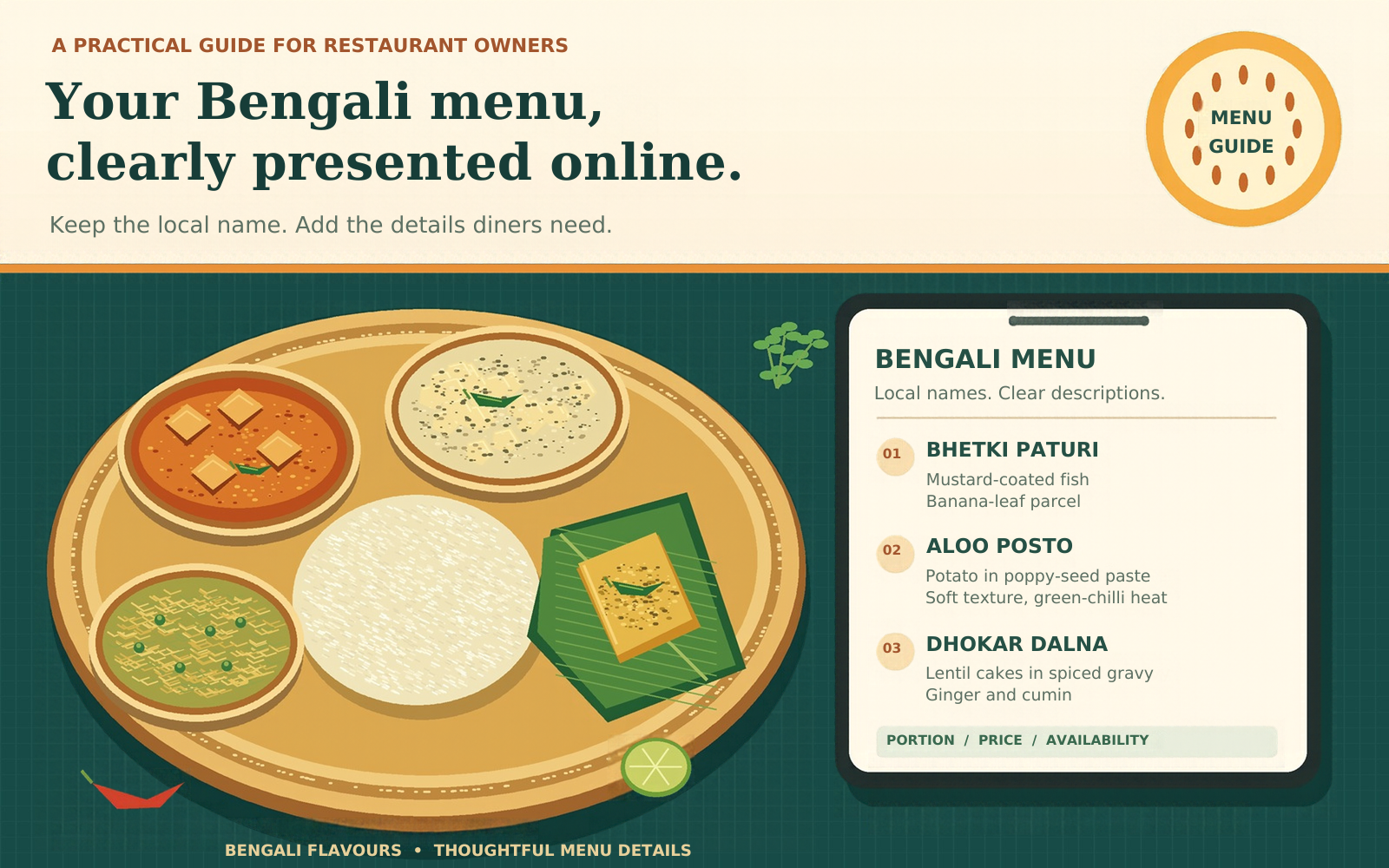
After: “Bhetki Paturi — bhetki fillet coated in mustard paste and mustard oil, wrapped in banana leaf and steamed. Pungent mustard flavour with green-chilli heat. One parcel; rice ordered separately.”
If you pan-cook the parcel instead, say so. Mention coconut, yoghurt or other additions when used, and check any boneless claim with the kitchen.
Aloo posto
Before: “Potato with special paste.”
After: “Aloo Posto — potato pieces cooked in poppy-seed paste with green chilli and nigella seeds. A soft-textured side with an earthy, nutty flavour. Pairs well with rice and dal, ordered separately.”
Here, “nutty” describes flavour; it does not identify the ingredients or establish whether the dish is suitable for someone with an allergy. List the ingredients your kitchen uses.
Dhokar dalna
Before: “Traditional vegetarian curry.”
After: “Dhokar Dalna — fried Bengal-gram lentil cakes and potato in a ginger-and-cumin gravy. Warmly spiced with a soft, sauce-soaked texture. Rice or roti ordered separately.”
Add the number of lentil cakes per portion. Check additions such as flour, peanuts and ghee before making gluten-free, nut-free or vegan claims.
Badhakopir ghonto
Before: “Seasonal mixed veg.”
After: “Badhakopir Ghonto — finely shredded cabbage cooked down with potato, peas, ginger and warming spices, finished with ghee. A lightly sweet, mostly dry preparation. Rice ordered separately.”
This example describes a vegetarian version containing dairy. If your preparation includes prawns or fish, state that prominently and place it in the appropriate menu section.
A reusable structure for every dish
You do not need a long story under every item. Use this structure to cover what a diner needs to know:
Local dish name — main ingredients + preparation + flavour or texture + accompaniments.
Then add: portion, price, availability and relevant dietary information.
- Ingredients: identify the fish, meat, vegetable or lentil, plus the defining sauce or paste. “Rohu” tells a diner more than “fish.”
- Preparation: use an accurate verb such as steamed, fried, simmered or slow-cooked. Avoid describing every preparation as roasted or grilled.
- Flavour and texture: choose useful details such as mustard-pungent, gently sweet, chilli-hot, thin-gravied or mostly dry. “Delicious” does not help someone compare dishes.
- Accompaniments: distinguish “served with rice” from “pairs well with rice.” The first implies it is included; the second should be followed by a separate-order note where needed.
Keep the description easy to scan. If an ingredient changes according to the day’s supply, agree how the listing will show that change rather than quietly substituting it.
Menu-preparation checklist: portions, prices and availability
Use one master sheet so your printed menu, website and listing information can be checked against the same source.
- Dish names: choose consistent spellings and keep genuinely different preparations separate.
- Portions: specify pieces, parcels, approximate serving weight where useful, or the contents of a set meal. Explain what “half” and “full” mean.
- Prices: record the current rupee price for each portion and branch. Make the tax treatment and any applicable extra charges clear. Avoid listing an old promotional price as the everyday price.
- Included items: name the rice, dal, bread, chutney or other accompaniments that actually come with the dish. Separate optional add-ons.
- Availability: mark lunch-only dishes, weekend specials, seasonal items and any advance-order requirement. Arrange a way to update unavailable items.
- Dietary details: verify vegetarian, vegan and no-onion/no-garlic labels. Record relevant ingredients such as fish, prawns, milk, wheat, peanuts and mustard. Give staff a clear route for answering allergy and cross-contact questions.
- Photos: use your own current dishes, showing the normal portion. Check that the photograph and description refer to the same preparation.
- Branch information: confirm the address, map location, contact number, opening hours and kitchen timings.
- Ownership: nominate a person to check updates and record when the menu was last reviewed.
A useful sheet has these columns:
section | dish name | description | portion | price | included sides | dietary notes | availability | photo filename | last checked.
Put unknown details back to the kitchen or manager before publishing.
What to ask a restaurant listing platform in India
A good-looking profile is only useful if its information stays accurate. Before choosing a platform, ask how menus are submitted, who checks the first listing, and how owners request later changes.
Find out whether separate branches and portion variants can be presented clearly. Ask how seasonal dishes, unavailable items and updated prices are handled. Check the menu on a phone: can someone read the description and price without repeatedly zooming into a photograph?
Also confirm any fees, support arrangements and the route diners use to contact your business. Discuss the features you need directly rather than assuming every listing service includes ordering, payments, reservations or delivery.
Use FoodCity as an additional menu-showcase channel
For people looking to discover restaurants online in India, useful menu information can turn an unfamiliar dish name into something they feel comfortable asking about or trying.
FoodCity presents restaurant information, specialities and menus, helping diners explore listed businesses and connect with them directly. You can explore Basanta Cabin’s menu and restaurant profile for a live example of menu sections, portions and prices. FoodCity focuses on discovery and connection; it does not handle food delivery.
You can consider FoodCity as an additional channel alongside your existing website and other restaurant profiles. Prepare a consistent menu pack, then discuss the listing process, supported presentation options and update arrangements with the team. A listing is another place to display your information, not a guarantee of enquiries or bookings.
Check the published menu as a first-time diner
Once the menu is online, open it on a phone and choose three dishes you know well. Can a new diner identify the main ingredient, understand the preparation, see the portion and price, and tell whether rice is included? Can they find the correct branch and ask a question?
Ask a colleague unfamiliar with the descriptions to do the same. Fix the questions they cannot answer, then repeat the check whenever your recipes, prices or availability change. The aim is to preserve your kitchen’s identity while making the menu easier to use.
Preparing your restaurant’s online menu? Enquire about listing your restaurant and presenting its menu on FoodCity.