
blog
How to Grow Your Restaurant in India Without Zomato or Swiggy
16 April 2026The Structural Crisis of Aggregator Dependency in the Indian Market
The contemporary landscape of the Indian food and beverage industry is characterized by a paradox of high visibility and diminishing profitability. For the majority of small to mid-sized establishments, the initial promise of digital aggregators has transitioned from a growth catalyst to a structural burden. As the industry moves through 2025 and 2026, the reliance on a duopolistic framework dominated by Zomato and Swiggy has created an environment where restaurant owners often struggle to maintain a viable bottom line. The fundamental issue is not merely the presence of these platforms but the absolute control they exert over the customer relationship, pricing power, and brand identity.
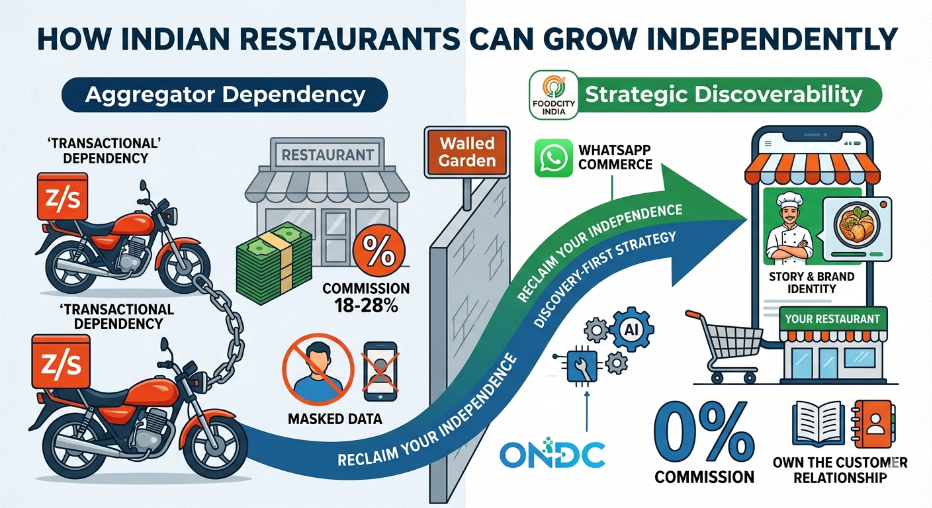
This report examines the mechanisms through which restaurant owners can reclaim their operational independence. It identifies the critical shift from “transactional dependency” to “strategic discoverability.” By leveraging the best restaurant listing platform in India and adopting modern digital marketing trends, establishments can build a sustainable model that prioritizes direct connection. The current trajectory of platform fees and commissions suggests that the “easy” volume provided by aggregators comes at a cost that is increasingly unsustainable for the average kitchen.
The analysis indicates that the evolution of the Indian diner has entered a new phase. While convenience remains a driver, there is a growing segment of “intentional diners” who seek to discover restaurants online in India based on authenticity, niche cuisines, and direct brand engagement. This shift provides a unique opening for platforms like FoodCity to act as a bridge, allowing owners to showcase their menus and stories without the extractive costs of a third-party logistics intermediary.
The Economic Architecture of Modern Delivery Platforms
To understand the necessity of diversification, one must first dissect the fiscal reality of the current aggregator models. The cost of doing business on major platforms is no longer limited to a simple commission. It has evolved into a complex web of platform fees, delivery cuts, ad spends, and mandatory participation in deep-discounting cycles.
The Escalation of Platform Fees and Commissions
Since August 2023, the industry has witnessed an aggressive scaling of “platform fees” charged to the consumer, which indirectly impacts the restaurant’s ability to price competitively. Initially introduced at ₹2, these fees have risen by over 600% in under three years, reaching effectively ₹17.58 (inclusive of GST) per order by March 2026. This fee is a fixed line item that does not scale with order value, meaning it disproportionately affects low-ticket items like snacks or beverages.
For the restaurant owner, the commission structure remains the most significant drain on revenue. Most platforms charge between 18% and 28% as a base commission, but the true deduction is often much higher when logistics and payment processing are factored in.
| Fiscal Component | Aggregator Model (Est. 2025/26) | Direct Discovery Model (FoodCity) |
| Base Commission | 18% – 28% | 0% (Platform Focus is Visibility) |
| Platform Fee (Consumer) | ₹14.90 – ₹17.58 | None |
| GST on Commission | 18% of Commission | N/A |
| Forced Discounting | 10% – 25% (often required for ranking) | At Restaurant Discretion |
| Logistics / Delivery Fee | Included in Commission or extra cut | In-house or 3PL (Shadowfax/Dunzo) |
| Payment Settlement | Weekly | Direct / Instant (via own gateway) |
| Total Revenue Deduction | 35% – 40%+ | 5% – 15% (Logistics + PG) |
The analysis of a typical ₹300 order demonstrates the severity of the margin compression. After accounting for a 25% commission (₹75), GST on that commission (₹13.5), and a platform delivery cut (approx. ₹20), the restaurant is left with roughly ₹191.50 before even considering the cost of ingredients, labor, rent, or packaging. This leaves a net margin that is often too thin to absorb any inflationary spikes in raw material costs, such as the rising prices of crude oil or staples.
The Mathematical Reality of Contribution Margins
The sustainability of a restaurant is governed by its contribution margin per order. The formula used by analysts to determine the impact of these platforms often looks as follows:
$$CM = P – (V_c + C_{agg} + L_{fee} + P_{cost})$$
Where:
- $P$ is the menu price.
- $V_c$ is the variable cost of ingredients and labor.
- $C_{agg}$ is the aggregator commission.
- $L_{fee}$ is the logistics and platform fee.
- $P_{cost}$ is the packaging and marketing cost.
When $C_{agg}$ and $L_{fee}$ represent nearly 40% of $P$, the $V_c$ must be drastically reduced to maintain profitability, which almost inevitably leads to a decline in food quality. This creates a negative feedback loop where quality drops, ratings fall, and the restaurant is forced to spend more on “Sponsored Ads” within the app to maintain visibility.
The Data Sovereignty Gap and Brand Anonymization
Perhaps more damaging than the immediate financial cost is the loss of the customer relationship. Aggregators function as a “walled garden” where the customer belongs to the platform, not the restaurant.
The Masked Data Phenomenon
When an order is placed through a third-party app, the restaurant is frequently provided with “masked” data meaning they do not receive the customer’s phone number, email address, or ordering history. This prevents the establishment from building a loyalty database. Without this information, personalized marketing becomes impossible. A restaurant cannot notify its most frequent diners of a new seasonal menu or a special event because they literally do not know who those diners are.
This lack of transparency also complicates grievance redressal. If a delivery is delayed by a platform’s rider, the customer often blames the restaurant, leading to a negative review. Because the restaurant lacks the customer’s contact info, they cannot reach out to apologize, offer a refund, or provide a discount to win back the diner’s trust.
The Erosion of Brand Identity
In the standardized interface of a delivery app, every restaurant is reduced to a uniform template: a small logo, a name in a specific font, and a list of items. This “brand dilution” makes it difficult for a premium establishment or a high-quality local gem to distinguish itself from a ghost kitchen operating with lower standards. The personal touch—the story behind the chef, the ambiance of the space, the specific origin of ingredients—is lost in the scroll.
To counter this, owners must seek a restaurant visibility platform that prioritizes brand storytelling. FoodCity India emphasizes this “discovery first” approach, allowing restaurants to present their brand, specialty dishes, and unique value propositions to people looking for the best places to eat in their city.
Strategic Pillars for Non-Aggregator Growth
To successfully attract customers without relying on the duopoly, a restaurant must optimize its own digital ecosystem. This involves a combination of search visibility, social proof, and direct ordering technology.
1. Dominating Local Search Visibility
The majority of dining decisions in 2025 begin with an online search. Whether a user is looking for “biryani restaurants near me” or “places to eat nearby,” the first few results on search engines dictate where the money flows.
- Google Business Profile (GBP) Optimization: This is the most critical asset for any physical restaurant. A claimed and fully optimized profile with high-quality photos, updated hours, and active review management is essential for appearing in the “Local Pack”.
- Leveraging Restaurant Listing Platforms: Being featured on the best restaurant listing platform in India provides a powerful “backlink” and secondary discovery point. Platforms like FoodCity are optimized to rank for high-intent keywords like “top restaurants in India” or “discover restaurants online India,” which can drive traffic to a restaurant that might not have a massive SEO budget of its own.
- Menu Keyword Integration: Digital menus should not just be PDF uploads. They need to be text-based and optimized with keywords. Instead of just listing “Schezwan Noodles,” a description should include terms like “authentic spicy Chinese restaurants’ style noodles,” which captures more search intent.
2. The Shift to Conversational Commerce (WhatsApp)
In the Indian market, WhatsApp is not just a messaging app; it is the “operating system” for daily life. 2025 has seen a massive surge in “WhatsApp Commerce,” where brands engage with customers directly for orders and support.
| Feature | WhatsApp Business Strategy | Impact on ROI |
| Direct Ordering | Customers order via a chat assistant. | Zero commission; higher retention. |
| Automated Loyalty | Bots send rewards for the 5th or 10th order. | Increases Customer Lifetime Value (CLV). |
| Personalized Nudges | “We noticed you haven’t ordered your favorite Biryani lately”. | Reactivates dormant customers at zero cost. |
| In-Chat Payments | End-to-end payment via UPI within the chat. | Reduces friction and cart abandonment. |
3. Redefining the Logistics Model
The primary reason restaurants stay on Zomato or Swiggy is the convenience of the delivery fleet. However, the rise of “Logistics as a Service” (LaaS) has decoupled delivery from discovery.
- 3PL Partners: Companies like Shadowfax and Dunzo provide B2B delivery services on a per-order basis. Studies suggest this can be 15% cheaper than the total commission-based cost of aggregators.
- ONDC (Open Network for Digital Commerce): This government-backed network allows restaurants to list on “buyer apps” and choose their own logistics provider. It aims to democratize the market and reduce the power of the duopoly.
- In-house Delivery for Hyper-Local Clusters: For orders within a 2-3km radius, employing a dedicated rider often results in faster delivery, better food handling, and a chance to include marketing collateral (like a “10% off for direct orders” flyer).
FoodCity India: A Solution for the Post-Aggregator Era
FoodCity India positions itself as the anti-aggregator—a platform designed to empower rather than extract. By focusing purely on visibility and direct connection, it solves the discovery problem without touching the restaurant’s profit margins.
The FoodCity Business Model: Visibility Without Friction
Unlike typical delivery apps, FoodCity does not handle the food delivery itself. Instead, it creates a professional digital identity for every restaurant, including multi-cuisine spots, cafes, and local street food vendors.
- Direct Contact Enablement: When a user finds a restaurant on the restaurant listing platform India, they are provided with the restaurant’s direct contact details. This facilitates a personal relationship where the owner can manage reservations, bulk orders, or specific dietary requests without a middleman.
- No Commission Model: Because FoodCity is not a delivery intermediary, it does not charge the 25-30% commissions that cripple small businesses. This allows the restaurant to offer better value to the customer or reinvest that margin into better ingredients.
- Global Expertise, Local Focus: Originating in Israel and adapted for the vibrant Indian market, the platform uses advanced digital marketing strategies to ensure that even small outlets can compete with large national chains.
Leveraging Cuisines for Targeted Discovery
The platform allows for highly granular categorization, helping customers find exactly what they are looking for.
- Biryani Restaurants: With “Biryani” being one of the most searched food terms in India, FoodCity optimizes for this specific niche, helping local favorites stand out against commercial chains.
- Chinese Restaurants: By showcasing unique menu items and authentic flavors, the platform helps Chinese cuisine spots attract diners who are tired of standardized “mall food”.
- Street Food Discoverability: Small vendors who could never afford aggregator commissions can list their restaurant and become visible to a city-wide audience, transforming from a “neighborhood secret” to a “destination spot”.
Technological Innovations Shaping 2025-2026
The restaurant industry is currently undergoing a “technological revolution” involving AI and automation that can be harnessed by independent owners to level the playing field.
AI-Powered Marketing and Operations
Artificial Intelligence is no longer a luxury. It is being used to optimize every facet of the restaurant business:
- Predictive Demand Forecasting: AI tools analyze past order data and external factors like weather or holidays to help kitchens prepare the right amount of food, reducing waste and stockouts.
- Personalized Digital Menus: Some platforms now offer menus that change based on who is looking. If a user has identified as vegan, the AI can prioritize vegan options at the top of the digital storefront.
- Voice Assistants for Ordering: AI-powered voice bots can handle telephone inquiries and basic orders, freeing up staff to focus on in-person hospitality.
The Role of Transparency and Sustainability
The 2025 consumer is increasingly concerned with the origin of their food and the environmental impact of delivery.
- Eco-Friendly Packaging: Moving toward biodegradable or reusable containers is no longer just a trend; it is a brand requirement for premium segments. While these increase costs, they also build significant brand loyalty among Gen Z and Millennial diners.
- Hygiene and Transit Safety: IoT-enabled packaging that monitors temperature during delivery ensures that “time-sensitive items” like pizza or sushi reach the customer in optimal condition.
Operational Excellence: The Foundation of Direct Growth
Marketing can get a customer to try a restaurant once, but only operational excellence ensures they come back.
Managing Food Quality in Transit
One of the biggest risks of direct delivery is the degradation of food quality. To overcome this, owners should:
- Optimize the Menu for Delivery: Certain items simply do not travel well. A restaurant might choose to offer its full menu for dine-in but a “Delivery-Hardy” curated list for online orders.
- Spill-Proof Packaging: Investing in high-quality, heat-sealed containers prevents the “soggy” textures that lead to 1-star reviews.
- KPT (Kitchen Preparation Time) Optimization: Minimizing the time between “order placed” and “handover to rider” is the most effective way to ensure food arrives hot. AI tools can help identify bottlenecks in the kitchen workflow.
Building a Strong Review Ecosystem
Review management is the “social currency” of the modern restaurant industry.
- Encourage Positive Feedback: After a positive experience, a simple SMS or WhatsApp message asking for a Google review can significantly boost a restaurant’s ranking.
- Address Negative Reviews Promptly: A thoughtful response to a negative review shows potential customers that the owner cares about quality. It can often turn a “detractor” into a “promoter” if the issue is handled with transparency.
Future Outlook: The Decentralization of Food Discovery
The trajectory of the Indian food market suggests a move away from “Super Apps” toward specialized discovery. As consumers become more discerning, they are less likely to scroll through a generic list of 500 restaurants and more likely to use a platform that offers curated, high-quality recommendations.
The rise of “Vocal for Local” and a focus on authentic culinary experiences favors the independent restaurant owner. By utilizing a restaurant listing platform that does not take a cut of every meal, owners can reinvest in their craft. The goal for 2026 is for restaurants to use aggregators as a supplementary channel while making their primary home on a platform that they control.
Conclusion and Strategic Summary
The data is clear: the current model of aggregator reliance is reaching its logical limit. With platform fees and commissions consuming nearly 40% of order value, the “volume” provided by these platforms is often unprofitable. To thrive, Indian restaurant owners must adopt a “Discovery-First” strategy.
By listing your restaurant on a platform like FoodCity India, you gain the visibility of a major app without the extractive fees. This allows you to:
- Own the Customer Data: Build direct relationships and loyalty programs.
- Protect Profit Margins: Retain 100% of your food revenue.
- Enhance Brand Identity: Tell your unique story through a professional digital storefront.
- Leverage Modern Tech: Use WhatsApp, AI, and ONDC to stay ahead of the curve.
The path to independence starts with visibility. When you list your restaurant online through a dedicated discovery platform, you are not just getting more customers; you are getting your customers back.